'Blue and light green.'
What's your favourite colour?
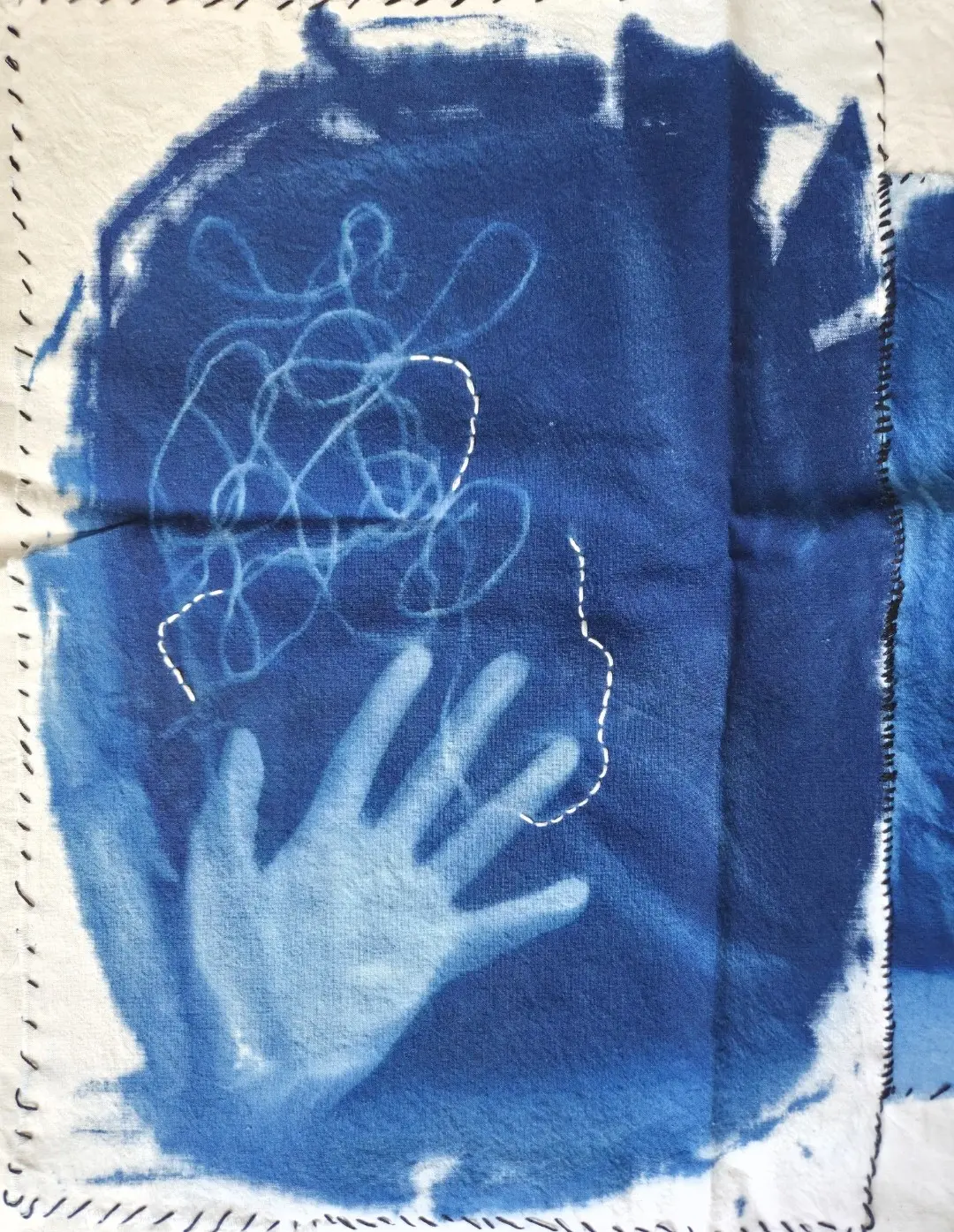
For an artist who makes cyanotypes, that first answer is about as close to a confession as it gets. A cyanotype is one of photography’s oldest tricks. You coat paper or fabric in iron salts, lay something on top, leave it in the sun, then wash it in water, and whatever was blocking the light appears as a ghost against a deep Prussian blue. If you love blue, it is a very convenient process to fall in love with. Chidinma fell head over heels for it, along with a good many other processes most photographers never touch.
She describes herself as “an experimental photographic artist exploring photography beyond the conventional image,” which is a polite way of saying the camera is only sometimes involved. She works across digital and analogue, “often using chemistry, fabric, stitching and everyday materials.” Her photographs can be painted, washed, sewn and handled, and some of them have never been near a lens at all. Photography without the camera, distilled down to a playful scientific process that closer resembles chemistry.
It started the way it starts for a lot of artists, with a child who could not leave things alone. “Drawing and making things as a child,” she remembers. “I’ve always been curious about creating with my hands and experimenting with materials.” Lucky for us and the art world, that childhood curiosity never really went away. Instead it found a darkroom.
Ask her which tool she could not live without and she skips the camera entirely. “My hands. They’re probably my most important tool because so much of my work involves direct interaction with materials.” That is not false modesty. Spend any time with her chemigrams and you can see why. A chemigram is made without a camera, by applying developer, fixer and whatever resist takes your fancy directly onto photographic paper, in the light, and watching what the chemistry decides to do. It is less like taking a picture and more like cooking with ingredients.
There was no single eureka piece for Chidinma. “Rather than one particular work, discovering experimental photography as a whole was the turning point.” What hooked her was the unpredictability. She talks about being “amazed by its possibilities for exploration,” and by the fact that “no two outcomes are ever quite the same.” It also gave her a way to experience photography “beyond the frame through more immersive processes,” which in her case has meant reaching well past the print altogether.
That reach has taken her a long way from Wiltshire. Her work has been shown at FOTOhof in Salzburg, Kranj Foto Fest in Slovenia, the Bamako Biennale in Mali, Dubai Expo, and the British Journal of Photography’s OpenWalls exhibition in Arles. She has been published in SKEW Magazine, See-Zeen and F-Stop Magazine, shortlisted for the Wolf Suschitzky Photography Prize, and awarded an Arts Council England Develop Your Creative Practice grant. More recently she took part in Amplify:XR Labs at Belfast XR Festival as a collaborator and director, which is the kind of sentence that would have baffled the early pioneers of the cyanotype quite thoroughly.
Running underneath all of it are the same few ideas: memory, materiality, transformation, and the relationship between the body and the photographic image. Touch and trace matter to her. A stitched photograph has been held, pierced and pulled through by a human hand, and you can tell.
Her inspiration comes from close to home. “In everyday materials, personal experiences and experimentation.” She is particularly interested in “what happens when I introduce something unexpected into a photographic process,” which is either the most artistic sentence in this article or the opening line of every school science accident ever recorded. The difference is that Chidinma knows exactly what she is doing, and that is the bit people tend to miss.
“That experimentation means there is no intention behind the work,” she says, when asked what gets misunderstood. Chance plays a big part, she freely admits, but chance is not the same as carelessness. “I’m interested in creating the conditions for unexpected things to happen.” Think of it as setting a table for a guest you have never met. You cannot control what they say when they arrive, but you chose the room, the chairs and the menu.
At the moment she is building on all of that with new hybrid works that combine digital imagery with analogue and material processes, pulling chemigrams, cyanotypes, fabric and hand stitching together into single pieces. It is old photographic chemistry and new technology sharing the same surface, held together with thread.
Being on the BRUT list, for her, “feels like recognition of the experimental direction my practice has taken,” and a chance to connect with a wider creative community. For someone whose work has travelled from Salzburg to Bamako, it is good to have a community back home too.
Her advice is short and sounds like it was learned the hard way, probably over a sink full of spoiled prints. “Stay curious and keep experimenting. Not everything has to work; sometimes the unexpected result takes the work somewhere more interesting.” Given how many of her best pieces began with something going not quite to plan, she is living proof of these words.
Thank you Chidinma, for becoming a part of our growing community of outsider artists here in Swindon and Wiltshire, and for sharing your story.
The Interview
1. What is your first memory of making art?
‘Drawing and making things as a child. I’ve always been curious about creating with my hands and experimenting with materials.’
2. How would you describe your practice?
‘I’m an experimental photographic artist exploring photography beyond the conventional image. I work across digital and analogue processes, often using chemistry, fabric, stitching and everyday materials.’
3. What tool could you not live without?
‘My hands. They’re probably my most important tool because so much of my work involves direct interaction with materials.’
4. Was there a particular work that changed the direction of your practice?
‘Rather than one particular work, discovering experimental photography as a whole was the turning point. I was amazed by its possibilities for exploration, the uniqueness of results, and the fact that no two outcomes are ever quite the same. It also opened up ways for me to experience photography beyond the frame through more immersive processes.’
5. Where do you find inspiration?
‘In everyday materials, personal experiences and experimentation. I’m often interested in what happens when I introduce something unexpected into a photographic process.’
6. What do people misunderstand about your work?
‘That experimentation means there is no intention behind the work. Chance is important to my practice, but I’m interested in creating the conditions for unexpected things to happen.’
7. What does being part of the BRUT List mean to you?
‘It feels like recognition of the experimental direction my practice has taken and an opportunity to connect with a wider creative community.’
8. What are you working on at the moment?
‘I’m developing new hybrid photographic works combining digital imagery with analogue and material processes, including chemigrams, cyanotypes, fabric and hand stitching.’
9. What’s your favourite colour?
‘Blue and light green.’
10. What advice would you give to other artists?
‘Stay curious and keep experimenting. Not everything has to work; sometimes the unexpected result takes the work somewhere more interesting.’