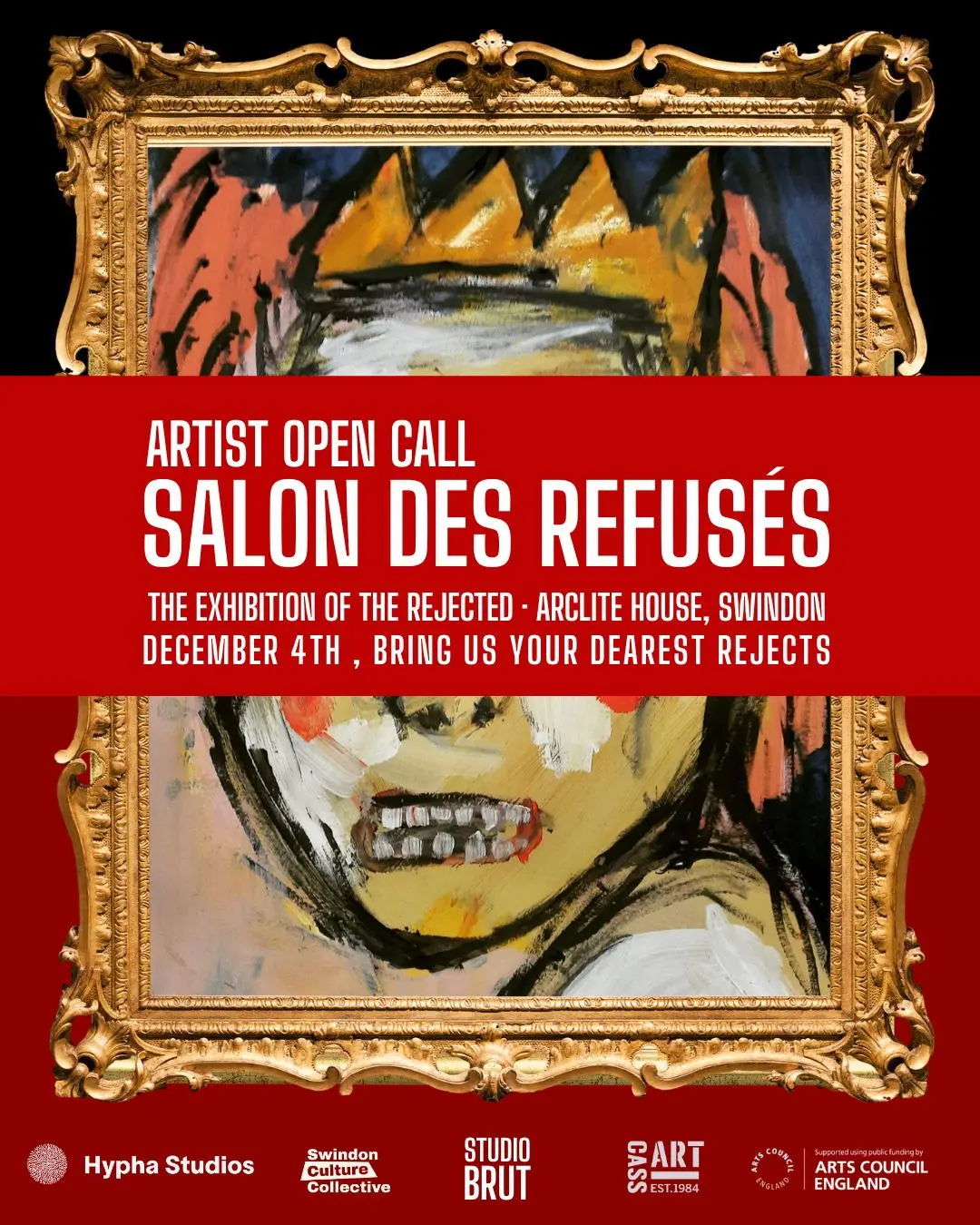
By Harrie Dearing. First published on harriedearingart.com.
Every artist I know has a drawer full of rejections. Open calls that said no, galleries that never wrote back, competitions where your name wasn’t on the list. Even the ugly little odd ball we condemn ourselves, because ‘ it doesn’t quite fit ‘ . We don’t usually talk about them. We tuck them away and pretend they didn’t sting.
But heres the fun thing … one of the most important art shows in history, was made entirely of rejected work. It happened in Paris in 1863, and the infamous exhibit was called Salon des Refusés, the exhibition of the rejects. This December, at Studio BRUT in Swindon, we’re holding our first group exhibition as a tribute to this iconic moment of defiance. Here’s the story of the original, and why it still matters to anyone making art outside the system.
Paris, 1863: the year the jury said no
In 19th-century France there was really only one way to make it as an artist: get into the Paris Salon. It was the official, state-run exhibition, and it was enormous. Around half a million people went through its doors over eight weeks. If the Salon jury rejected you, you had very few other places to show, and your living suffered for it.
The jury had firm ideas about what ‘good art’ looked like. History painting was at the top of the ladder: grand scenes from the Bible, myth and politics. Judges expected noble subjects and a smooth, perfect finish. Loose brushwork and everyday life were not what they were looking for.
In 1863 the jury was especially harsh. More than 5,000 works were submitted and fewer than 2,218 were accepted. The rejected artists were furious, and their protests grew loud enough to reach Emperor Napoleon III. He paid a surprise visit to the Palais de l’Industrie, where the Salon was being hung, to see the rejected work for himself. Then, keen to keep the public on side, he ordered that the refused works should have an exhibition of their own.
Inside the show of rejects
The Salon des Refusés opened on 15 May 1863, just a stone’s throw from the official Salon. Not everyone was brave enough to take part. About a thousand artists withdrew their work rather than be publicly labelled a reject. Even so, 410 artists stayed and hung their work. Proudly standing by their artwork in the face of rejection. It’s just so rock and roll …
The public came in droves. Reports talk of over a thousand visitors a day, and thousands more on Sundays, when entry was free. Many came to laugh. The press had a field day, and plenty of visitors treated it as a freak show.
But look at who was on those walls. Among the rejects were Édouard Manet, Paul Cézanne, Camille Pissarro, Henri Fantin-Latour, Johan Jongkind and James McNeill Whistler. Two paintings in particular got people talking:
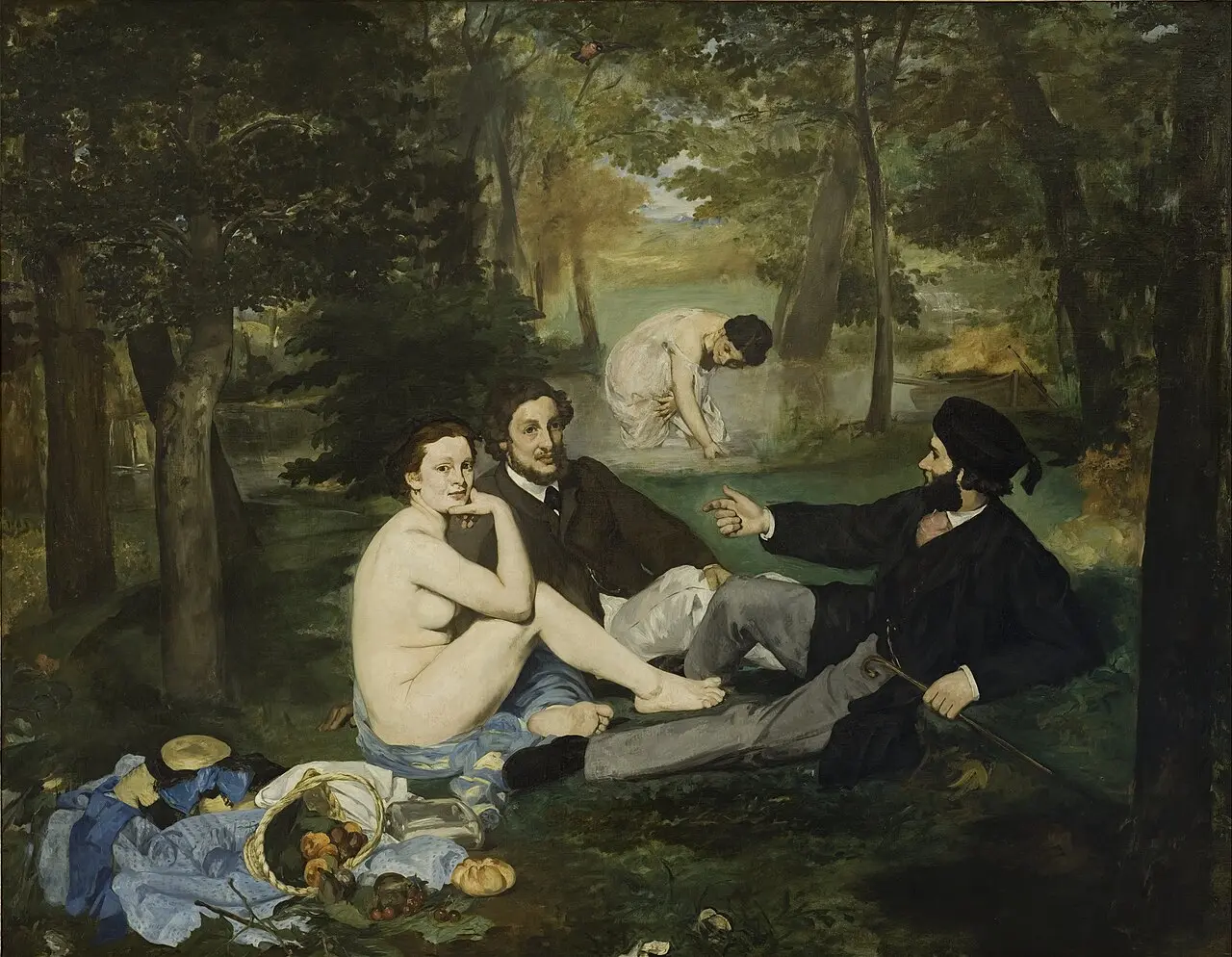
Manet’s Le Déjeuner sur l’herbe (shown under the title Le Bain), a nude woman picnicking with two fully dressed men. Critics hated both the subject and the loose, sketchy painting. Today it is often called the first modern painting.
So why was it rejected ?
For starters, It was ‘the wrong kind of nude’. Nudes were everywhere in the Salon, so the nudity itself wasn’t the problem. They were acceptable as long as they were goddesses, nymphs or figures from myth, safely idealised and set in the distant past. Manet’s woman is a real, modern Parisian. How dare he… Then there is The suggestion of sex work. A naked woman with two well-dressed young men in the Bois de Boulogne pointed to something every Parisian knew. The park was associated with prostitution. A part of society they did not want hung upon the gallery walls for all to see. Such things did not belong on walls alongside deities and heroic battles. And you know what takes it one step further, She looks straight at you. The subject doesn’t look away modestly. She meets the viewer’s eye calmly and without embarrassment, which made viewers feel caught out, even complicit the taboo act. How dareeeeeeeee she ? The more I research into the reasons this painting was met with such rejection, the more I am genuinely falling in love with this painting. I’m a sucker for a good story after all…
Theres the more technical reasoning for the rejection too, something many outsider artists themselves can relate too, technique and how things are supposed to be done vs your own process as an artist. It looked unfinished. The academy prized a smooth, polished surface with invisible brushstrokes. Manet’s painting was loose and sketchy by comparison, with a hastily brushed background. Critics attacked his technique as much as his subject. It looked “wrong”. Manet used flat, harsh light and left out the soft shading that made figures look rounded, so the woman looks almost cut out. The bather in the background seems too big for her distance, and the space doesn’t add up. To the jury these looked like mistakes. But Manet was doing it on purpose. It was critiqued as A grand canvas for a “low” subject. At over two metres high and two and a half wide, it was the size of a heroic history painting. Using that scale for a picnic of modern people seemed like a joke at the academy’s expense. Manet’s chosen subject was unworthy of such grandeur. Finally the salon expressed that It mocked the old masters. Manet borrowed the composition from Raphael via an engraving, and the theme from Titian’s Pastoral Concert in the Louvre. The salon recognised the sources, and swapping gods for modern Parisians felt like a parody of sacred tradition. Where as today we accept this practice as a common tool for artists, using historic / academic reference images in the creation of contemporary works. . .
Now Manet himself is not regarded as an outsider artist. He was traditionally trained, and born into a position of privilege that guided his path into the art world. He spent about six years in the studio of the academic painter Thomas Couture and copied old masters in the Louvre. Nor was many of the other artists that partook in this protest tbh. But this moment in art history was such an iconic rebellion, that The Salon des Refusés became spiritual ancestor of outsider art movement. It’s the moment the art world first admitted its gatekeepers could be wrong, which opened the door to valuing work made entirely outside the system.
How a show of rejects changed art
The emperor meant the Salon des Refusés as a peace offering, a way to quieten the complaints. It ended up starting the long decline of the official Salon. For the first time, artists had seen that work could be shown outside the Salon, and that people would turn up to look.
The Salon des Refusés itself only ran again in 1864 and 1873. But its spirit spread:
-
1874: a group of artists, including several of the 1863 rejects, stopped asking the jury’s permission altogether. They put on their own independent show in Paris. A critic mocked Monet’s Impression, Sunrise, and the name stuck: the Impressionists.
-
1881: the state stepped back from running the Salon and handed it over to a private society of artists.
-
1884: the Salon des Indépendants launched with a simple rule: no jury and no prizes. It still runs today.
A show that was meant as a consolation prize is now remembered as the moment modern art arrived.
Why it matters to outsider artists
As a self-taught, outsider artist working in Swindon, this story feels close to home. The 1863 jury judged work on polish and approved subjects. The things they rejected, rough brushwork, ordinary people, a refusal to follow the rules, are exactly what we now value.
Outsider art has always lived on the wrong side of the jury. Many of the artists I admire never went to art school, never got the gallery call, and made their work anyway. The Salon des Refusés is a reminder that the gatekeepers of any era can be spectacularly wrong. It’s also a reminder that it takes courage to hang your work when you’ve been told it isn’t good enough. A thousand artists pulled out in 1863. The ones who stayed changed art history.
So I’d like us to stop hiding our rejections. They’re part of the work. They’re part of who we are as artist and as beautifully flawed human beings.
Our Salon des Refusés at Studio BRUT
Studio BRUT’s first group exhibition is our own Salon des Refusés, a show for work that got turned down somewhere else. That might be the open call that said no, the gallery that never replied, or the competition you didn’t place in. A rejection you gave yourself counts too. ( something artists do all too often, I’m very guilty of this myself )
Like this moment in art history, the story is EVERYTHING and the context elevates the artwork. So we want to raise your work in their own glorious rejection. How ? Every piece is shown with a short story of its rejection, printed right beside it. The rejection isn’t the embarrassing bit to leave out of the gallery walls. Your defiance of that rejection, and fight to proudly stand by your work despite it, is the exhibition.
The details
-
Free to enter, no commission
-
Up to three works, or a small set that belongs together, in any medium. Photography and digital work must be printed and framed, ready to hang.
-
Open to artists aged 18 and over
-
Entries close: 11:59pm, Sunday 8 November 2026
-
Opening night: Friday 4 December 2026, 7 to 9pm, at Studio BRUT, Arclite House, Century Road, Peatmoor, Swindon SN5 5YN. One night only, and free.
Read the full open call · Enter your work · RSVP for the opening night
Got a piece that was turned down? Dig it out of the drawer and send it to us. And if you just want to see what the gatekeepers missed, come along on 4 December. Questions ? contact us at hello@studiobrut.art