1945-2021 · Cuthbert, Georgia, USA
He survived a lynching attempt, served seven years on a Georgia chain gang, and turned it all into carved and dyed leather. His memoir won the Pulitzer Prize a year after he died.
The life
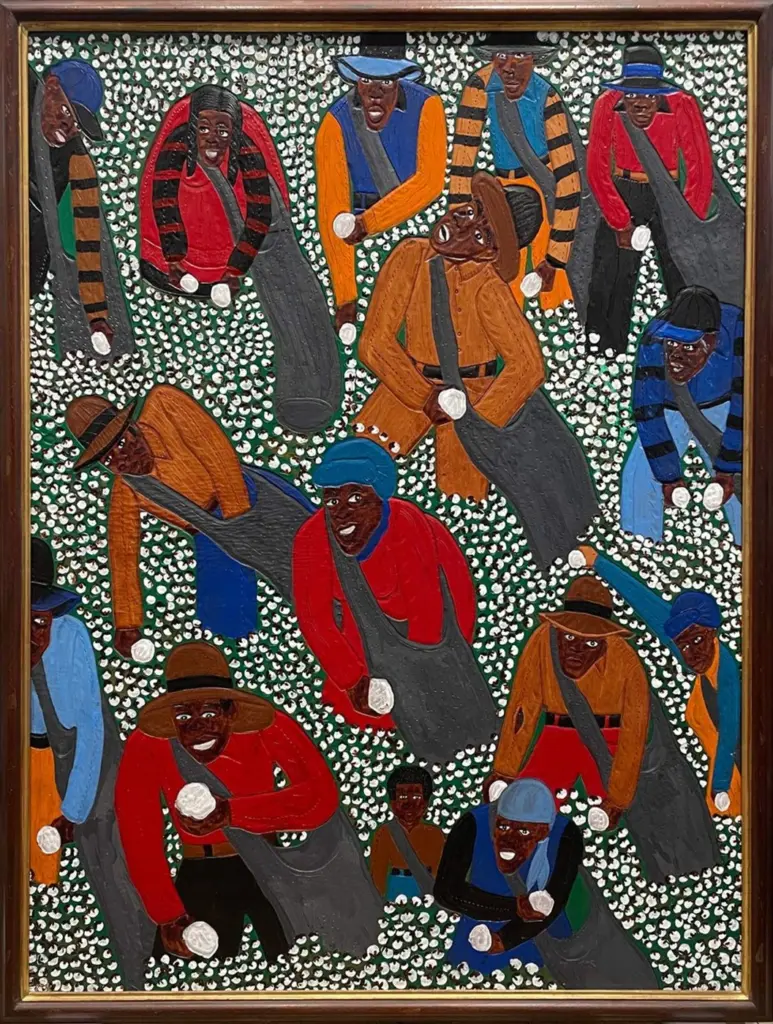
Rembert was born in rural southwest Georgia in 1945 and raised by his great-aunt in Cuthbert, picking cotton as a child. Arrested in the 1960s after a civil rights demonstration, he survived a lynching attempt, one of very few people known to have done so, and spent seven years on a chain gang, where a fellow prisoner taught him to tool leather. He married Patsy in 1974, raised a family in New Haven, Connecticut, and at 51, with her encouragement, became a full-time artist. A 2000 show at Yale University Art Gallery was his breakthrough, and his memoir Chasing Me to My Grave won the 2022 Pulitzer Prize for Biography after his death in March 2021.
The work
Scenes carved and tooled into stretched leather, then coloured with shoe dye: cotton fields in rhythmic rows, the stripes of the chain gang, juke joints, pool halls and church congregations, pattern carrying both the pain and the joy of the Jim Crow South. His work is held by the National Gallery of Art, Yale University Art Gallery, the Minneapolis Institute of Art and the Georgia Museum of Art.
Why we love them
He took the material of forced labour, leather and dye learned in prison, and made it sing. Memory as craft, testimony as pattern.
Go deeper
- Winfred Rembert at the Outsider Art Fair
- Winfred Rembert on Wikipedia
- Fort Gansevoort
- Where to see outsider art, our full list of museums and collections.
- The glossary, if any of the terms here are new.
Kindred spirits
Thornton Dial1928-2016, Bessemer, Alabama, USA
Horace Pippin1888-1946, West Chester, Pennsylvania, USA
Untrained and unstoppable, like them? Like us?