1871-1925 · Thuringia, Germany
He began by modelling figures from chewed bread on a hospital ward. Under the borrowed name Karl Brendel, his carvings went on to startle the Expressionists and the Surrealists.
The life
Genzel was born in Thuringia in 1871 and worked as a bricklayer, plasterer and moulder before his life was upended by mental illness and a partial leg amputation. Hospitalised in 1906 with schizophrenia, he began making art around 1912, first with chewed bread, then carving wood. The psychiatrist Hans Prinzhorn made him a centrepiece of his 1922 book Artistry of the Mentally Ill, giving him the protective pseudonym Karl Brendel: he was the only sculptor among Prinzhorn’s ten “schizophrenic masters”, and the book reproduced more of his work than anyone else’s. He died in 1925.
The work
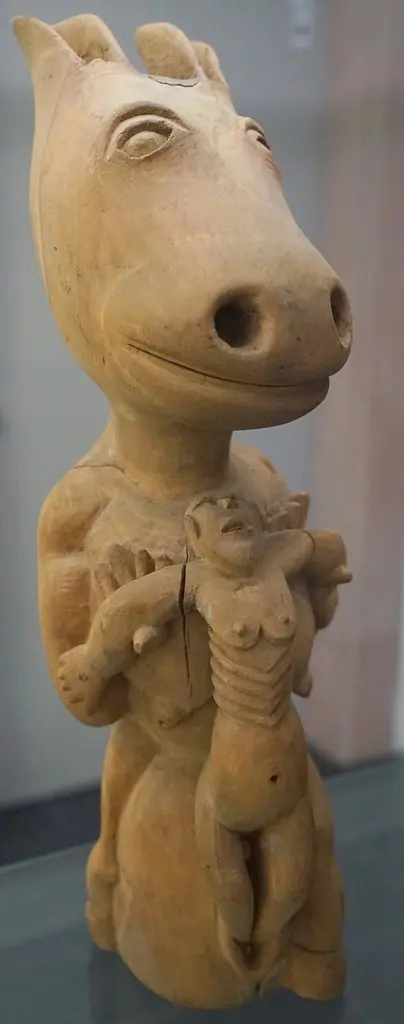
Carved hardwood figures, often painted or varnished, dense with religious feeling: Christ figures, hybrid beings such as his woman-Christ “Jesin”, and creatures with giant heads on stork-thin legs. German Expressionists and French Surrealists studied the reproductions, and Paul Klee absorbed his compositional ideas. His work is held by the Prinzhorn Collection at Heidelberg University Hospital and the Collection de l’Art Brut in Lausanne.
Why we love them
The avant-garde went looking for raw vision and found Genzel already there, decades ahead, carving it on a ward. Klee took notes. That says everything.
Go deeper
- Karl Genzel at the Outsider Art Fair
- Karl Genzel on Wikipedia
- Where to see outsider art, our full list of museums and collections.
- The glossary, if any of the terms here are new.
Kindred spirits
Adolf Wölfli1864-1930, Bern, Switzerland
Heinrich Anton Müller1869-1930, Münsingen, Switzerland
Untrained and unstoppable, like them? Like us?