1903-1982 · Gladbach, Germany
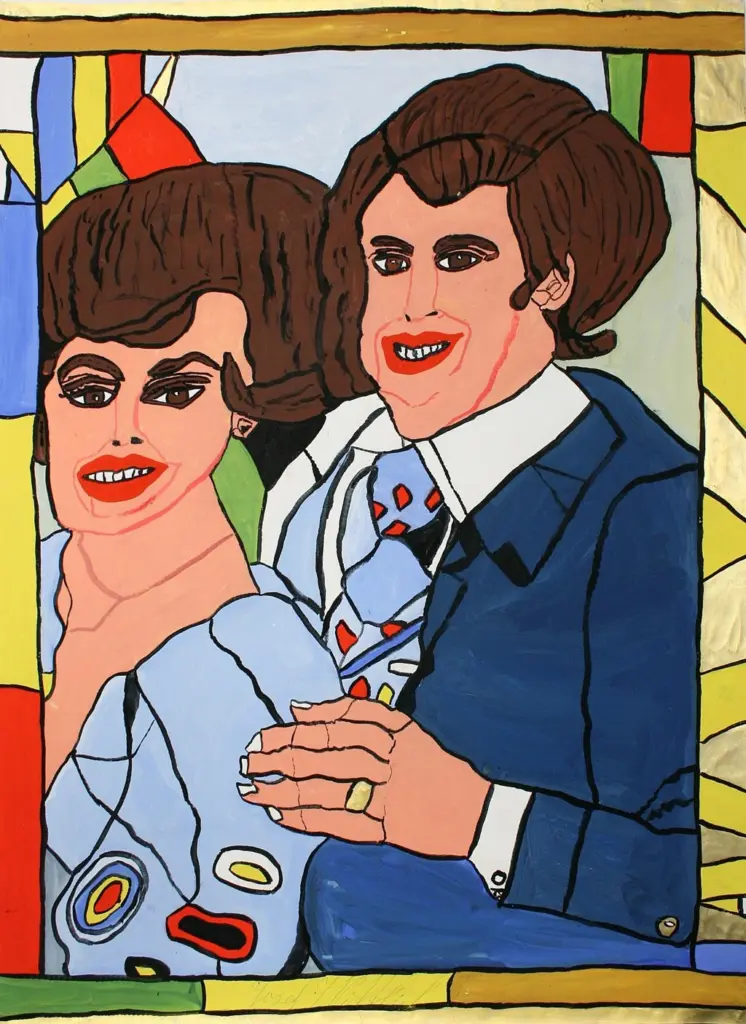
Pop art before pop art had a name: a ceramics factory labourer in the Westerwald, painting queens, popes and battle scenes in colours that shout across the room.
The life
Wittlich was born in Gladbach in the Rhineland in 1903 and had a punishing childhood, losing his mother young. He painted from his youth as a private refuge, was conscripted in the Second World War, wounded and taken prisoner, and from 1948 lived and worked at the Steuler ceramics factory in Höhr-Grenzhausen. In 1967 the artist Fred Stelzig discovered his paintings during a factory visit, and the Württembergischer Kunstverein in Stuttgart exhibited him the same year. He kept his factory job and kept painting until his death in 1982.
The work
Gouache and tempera on paper, worked up from reproductions of academic paintings, war books and magazine images: soldiers and battle scenes, royal couples, popes, models and mannequins, with hardened outlines, flattened forms and saturated, evenly laid colour that critics compared to pop art. His work is held by the Collection de l’Art Brut in Lausanne, the American Folk Art Museum in New York and, since 2021, the Centre Pompidou in Paris.
Why we love them
He made pictures as loud as Warhol’s on a factory wage, and never stopped clocking in. The colour alone is worth the trip.
Go deeper
- Josef Wittlich at the Outsider Art Fair
- Where to see outsider art, our full list of museums and collections.
- The glossary, if any of the terms here are new.
Kindred spirits
Willem van Genk1927-2005, The Hague, Netherlands
Drossos Skyllas1912-1973, Chicago, USA
Untrained and unstoppable, like them? Like us?