1910-1964 · Vendée, France
A village cobbler who painted totems on brooms, stones and old tin, wrote letters like nobody else in France, and told Dubuffet exactly what he thought of being collected.
The life
Chaissac was born in Avallon in 1910 into the rural working class and tried his hand as ironmonger, cobbler and brushmaker. In 1930s Paris his neighbours, the artists Otto Freundlich and Jeanne Kosnick-Kloss, saw his talent and pushed him to paint. Tuberculosis put him in sanatoria, where he kept working. He married a schoolteacher and settled in the Vendée, painting, writing poetry and prose for proletarian journals, and keeping up a famous correspondence with figures like Albert Gleizes and Raymond Queneau. Dubuffet admired him from 1946 but later filed him outside art brut proper, which stung: Dubuffet talked about art brut, Chaissac said, the phrase made a fortune, and I was fleeced. He died in 1964.
The work
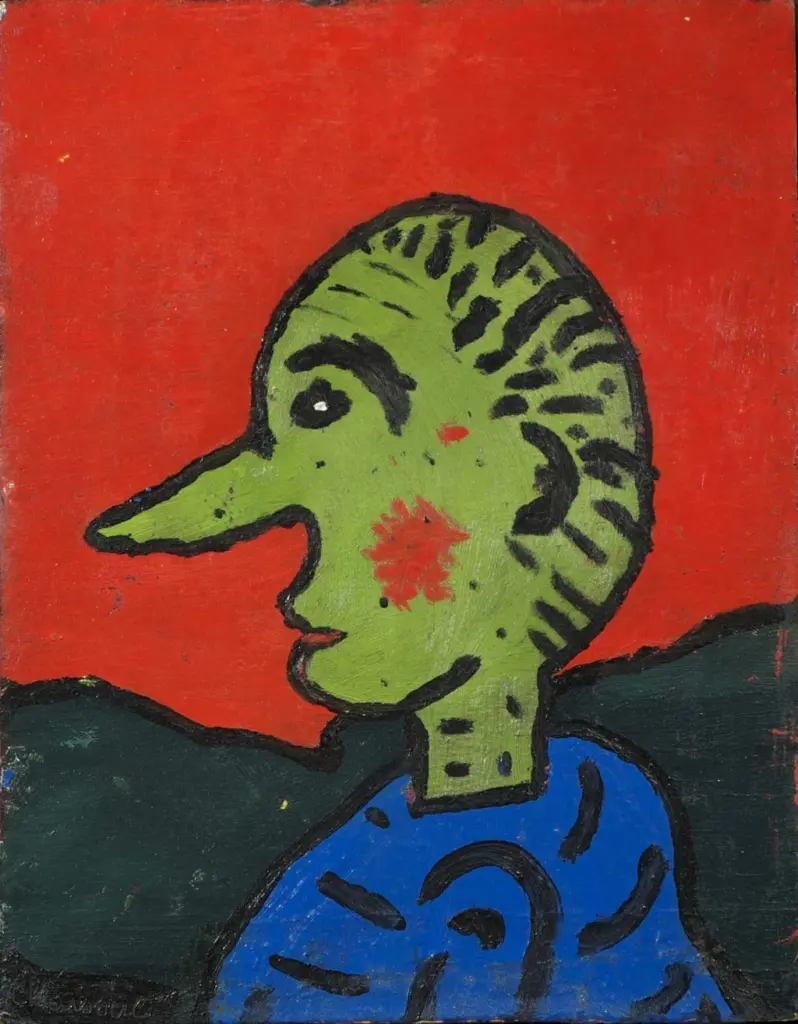
Brightly coloured figures built patchwork-fashion from bold outlined shapes, on canvas but also on brooms, branches, rocks, cans and whatever the village discarded, along with drawings, assemblages and painted objects. He called his manner rustic modern. The work is now in the Museum of Modern Art in New York, the Centre Pompidou and the Collection de l’Art Brut in Lausanne.
Why we love them
He refused every box, including the outsider one, and made the refusal funny. A one-man avant-garde with a cobbler’s hammer.
Go deeper
- Gaston Chaissac at the Outsider Art Fair
- Gaston Chaissac on Wikipedia
- Where to see outsider art, our full list of museums and collections.
- The glossary, if any of the terms here are new.
Kindred spirits
Alfred Wallis1855-1942, St Ives, Cornwall, UK
Michel Nedjarb.1947, Paris, France
Untrained and unstoppable, like them? Like us?