1891-1980 · Kennett Square, Pennsylvania, USA
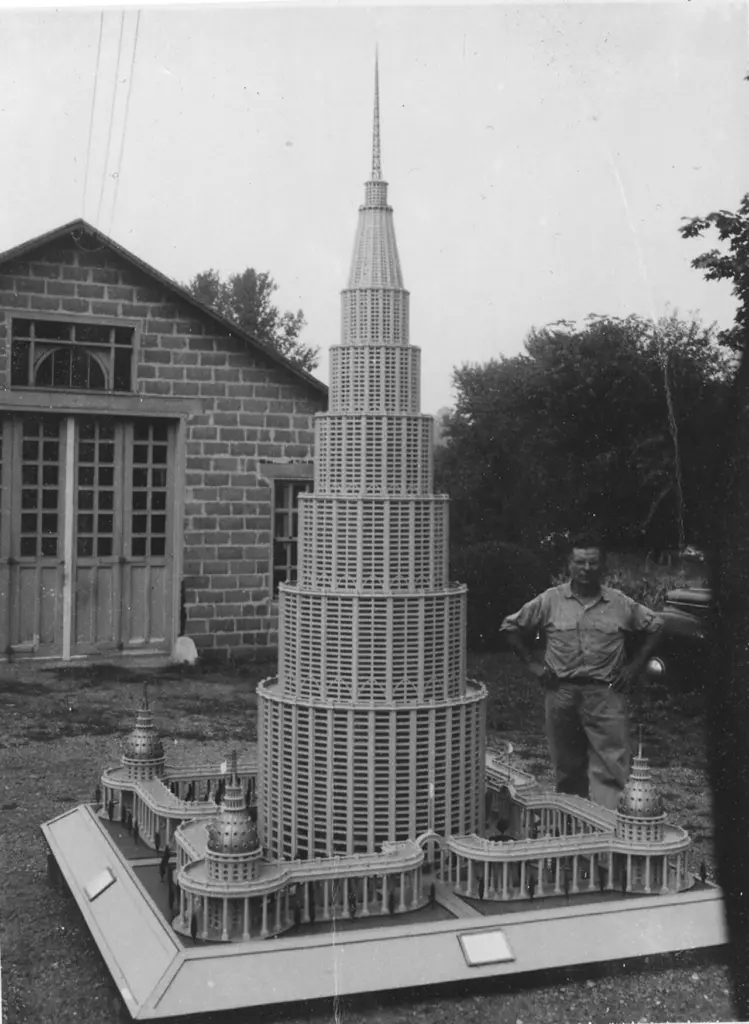
A Pennsylvania auto-body man patented a 136-storey museum designed to hold everything humanity knows. He built the model in his garage; decades after his death it starred at the Venice Biennale.
The life
Auriti was born in 1891 in Guardiagrele, Italy, and briefly studied architecture before the First World War; the passion never left him. His family’s route to America ran through Brazil, where he worked on coffee-processing machinery, and he eventually settled in Kennett Square, Pennsylvania, running an auto-body shop. In the 1950s he spent three years building The Encyclopedic Palace of the World, a 1:200 scale model of a museum for all human discovery, 136 storeys and 2,322 feet tall, to occupy sixteen blocks of Washington DC. He patented the design, US patent 179,277, and spent years seeking a home for it. He died in 1980; his granddaughter gave the model to the American Folk Art Museum in 2003, and in 2013 it became the centrepiece of the Venice Biennale.
The work
An eleven-foot architectural model in wood, plastic, glass and metal, detailed down to balustrades made from hair combs and model kit parts, accompanied by his declaration that the building would hold all the works of man in whatever field, discoveries made and those which may follow. It is in the permanent collection of the American Folk Art Museum, New York.
Why we love them
The most generous building never built: a garage mechanic’s gift of every human idea, filed under one roof.
Go deeper
- Marino Auriti at the Outsider Art Fair
- Marino Auriti on Wikipedia
- Where to see outsider art, our full list of museums and collections.
- The glossary, if any of the terms here are new.
Kindred spirits
Charles A. A. Dellschau1830-1923, Houston, Texas, USA
Willem van Genk1927-2005, The Hague, Netherlands
Untrained and unstoppable, like them? Like us?