c.1909-1989 · Rio de Janeiro, Brazil
A Brazilian sailor announced to a room of monks that he had been sent to judge the living and the dead, then spent fifty years in an asylum preparing the inventory he would present to God.
The life
Bispo was born around 1909 in Japaratuba, Sergipe, a descendant of enslaved people. He joined the navy in 1925, boxed, and worked odd jobs in Rio de Janeiro until December 1938, when a night of visions led him to the monastery of São Bento to declare his divine mission. He was committed, diagnosed with paranoid schizophrenia, and spent more than fifty years at the Colônia Juliano Moreira in Jacarepaguá, working alone in his cell. He refused the word artist, never sold a thing, and died there in 1989.
The work
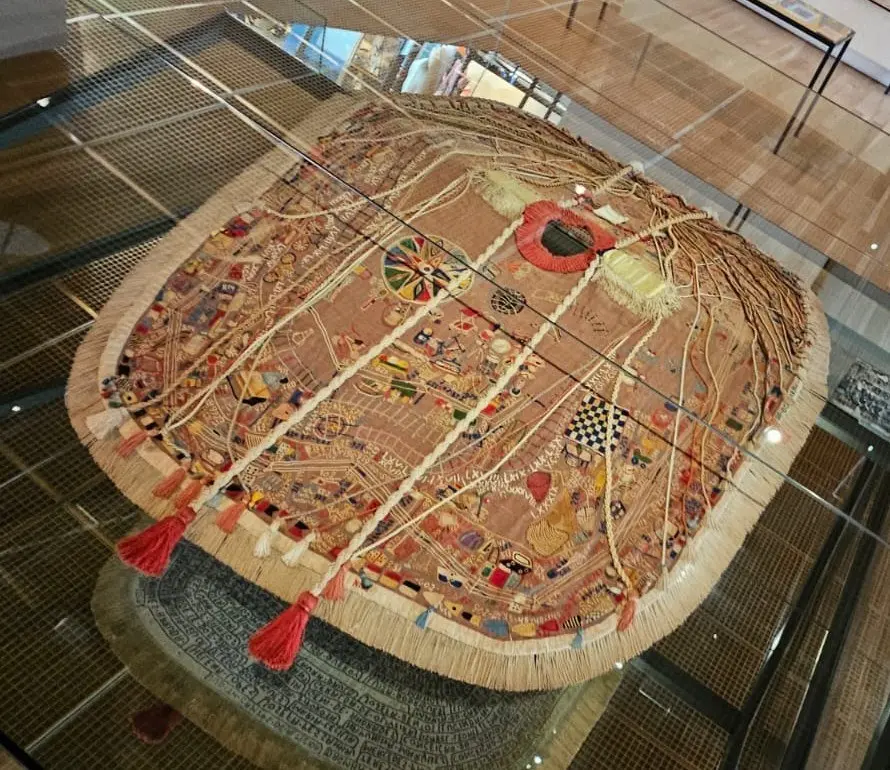
Over 800 objects made from ward salvage: banners and sashes embroidered with thread unravelled from uniforms, fleets of model boats, wrapped and bound miniature signage, and the Manto da Apresentação, the mantle he made to wear on Judgment Day. Shown at the Venice Biennale in 1995, his complete works are now protected as Brazilian national heritage at the Museu Bispo do Rosário in Rio.
Why we love them
He was not making art, he was making evidence. The most complete answer ever given to the question of why anyone makes anything.
Go deeper
- Arthur Bispo do Rosário at the Outsider Art Fair
- Arthur Bispo do Rosário on Wikipedia
- Museu Bispo do Rosário Arte Contemporânea
- Where to see outsider art, our full list of museums and collections.
- The glossary, if any of the terms here are new.
Kindred spirits
Adolf Wölfli1864-1930, Bern, Switzerland
Madalena Santos Reinbolt1919-1977, Bahia, Brazil
Untrained and unstoppable, like them? Like us?