1923-2014 · Abidjan, Côte d'Ivoire
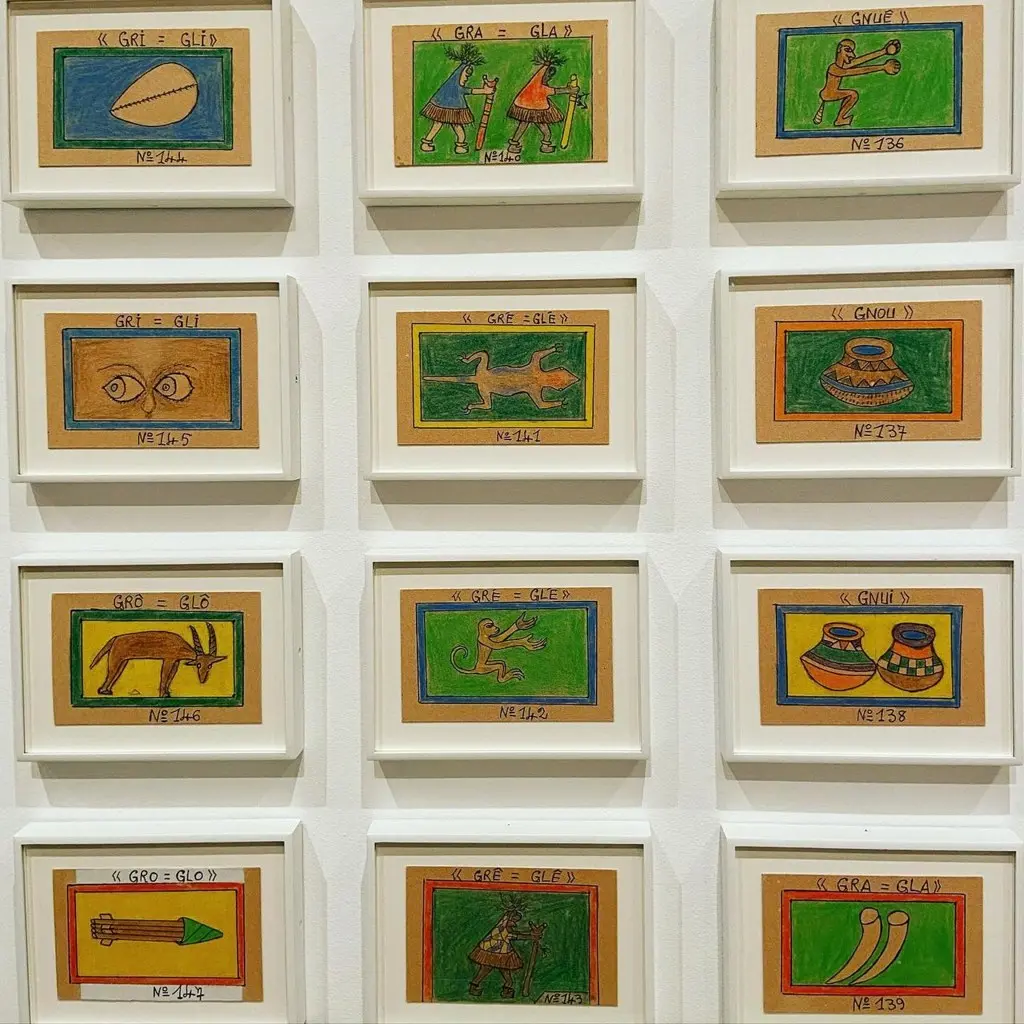
After a magnificent sunlit vision in 1948 he renamed himself Cheik Nadro, the Revealer, and set out to record everything in the world on small cards, one drawing at a time.
The life
Bouabré was born in 1923 in Zéprégühé, Côte d’Ivoire, and his schooling ended early through poverty. On 11 March 1948 he experienced what he called a magnificent sunlit vision, took the name Cheik Nadro and devoted himself to research: scarification patterns, the heavens, African and world history. He invented a syllabary of 448 characters for his Bété language to carry its heritage into writing. Recognition came through Magiciens de la Terre in Paris in 1989 and the Venice Biennale in 2013, and in 2022 MoMA gave him the retrospective World Unbound. He died in Abidjan in 2014.
The work
Hundreds upon hundreds of postcard-sized drawings in ballpoint pen and crayon: steam trains, animals, field tools, preachers and political leaders, each image ringed by a hand-written border of interpretation, the whole forming an open encyclopaedia of world knowledge. His work is held by Tate in London, the Collection de l’Art Brut in Lausanne and the National Museum in Abidjan.
Why we love them
He treated the entire universe as an archive to be catalogued in crayon. The alphabet he invented may yet outlive us all.
Go deeper
- Frédéric Bruly Bouabré at the Outsider Art Fair
- Frédéric Bruly Bouabré on Wikipedia
- Where to see outsider art, our full list of museums and collections.
- The glossary, if any of the terms here are new.
Kindred spirits
George Widenerb. 1962, Cincinnati, Ohio, USA
Melvin Way1954-2024, New York City, USA
Untrained and unstoppable, like them? Like us?