1898-1993 · Austin, Texas, USA
He spent three decades in a Texas institution before anyone handed him a crayon. Then, at 66, he produced two thousand drawings in ten years and stopped forever.
The life
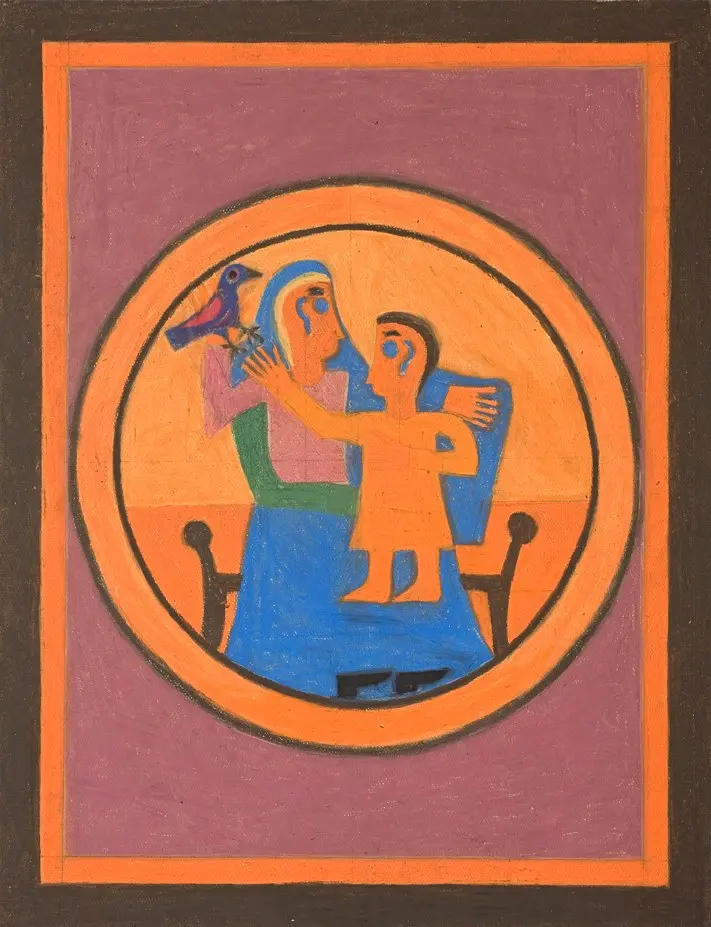
Arning grew up in a strict Lutheran farming family near Austin, Texas. Committed to Austin State Hospital in 1928 and again in 1934, he spent most of his adult life in institutions. In 1964 a teacher named Helen Mayfield gave him crayons and paper, and the results were extraordinary: well over two thousand drawings poured out between 1964 and 1973, first memories of farm life, then bold reworkings of magazine advertisements. He stopped drawing in 1973, after leaving his nursing home, and never picked up a crayon again. He died in McGregor, Texas in 1993.
The work
Crayon and, from 1969, oil pastel on paper, every sheet covered edge to edge in dense strokes of colour. Farm scenes, animals and figures flattened into stark, rhythmic compositions, and advertisements transformed so completely that the original source is often impossible to spot. His work is held by the Smithsonian American Art Museum, the American Folk Art Museum, the Museum of Fine Arts Boston and the Milwaukee Art Museum.
Why we love them
A whole career compressed into one ten-year window. It opened, the work blazed through, and it shut. What a window.
Go deeper
- Eddie Arning at the Outsider Art Fair
- Eddie Arning on Wikipedia
- Smithsonian American Art Museum
- Where to see outsider art, our full list of museums and collections.
- The glossary, if any of the terms here are new.
Kindred spirits
Martín Ramírez1895-1963, Jalisco, Mexico / California, USA
Inez Nathaniel Walkerc.1911-1990, New York, USA
Untrained and unstoppable, like them? Like us?