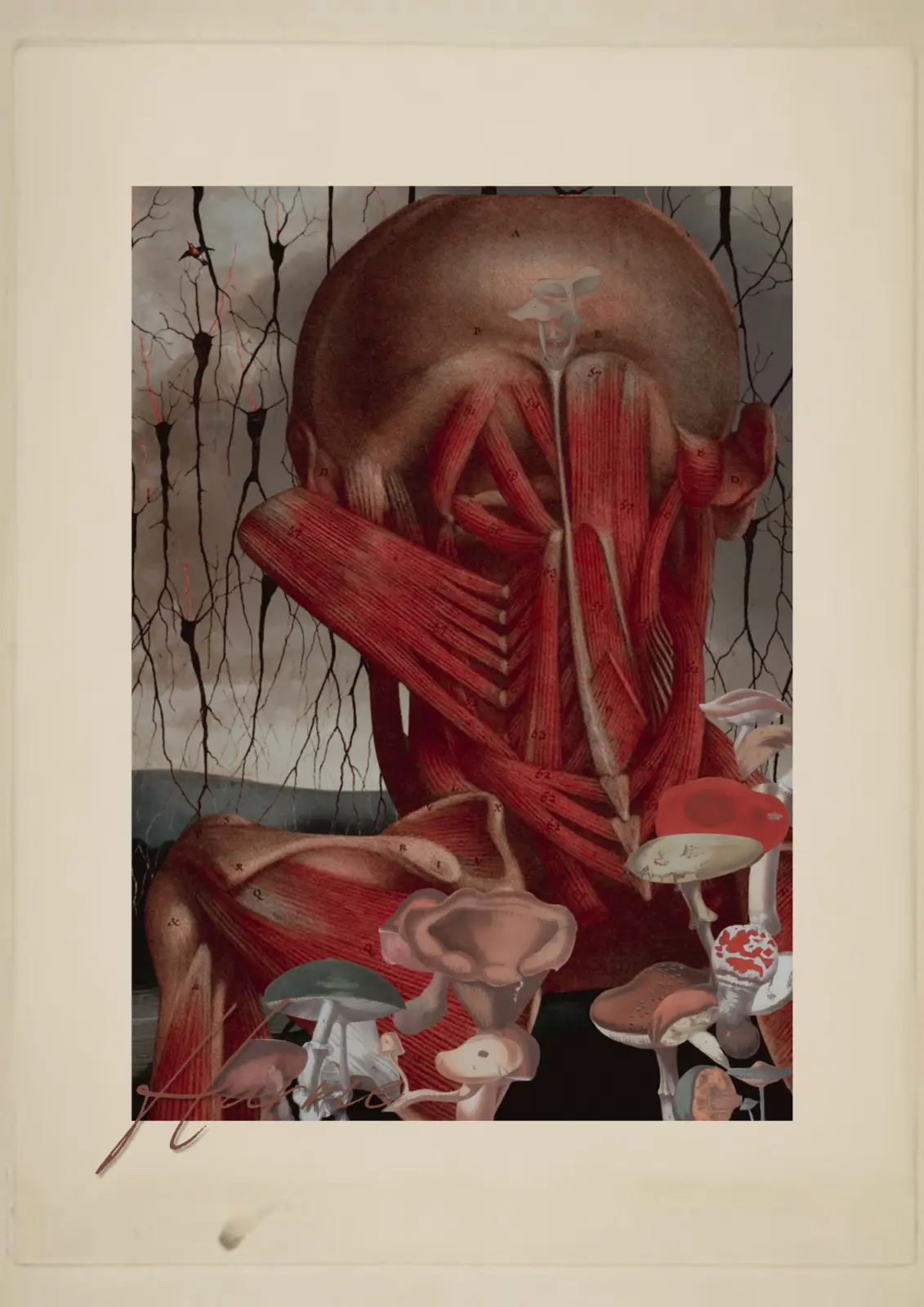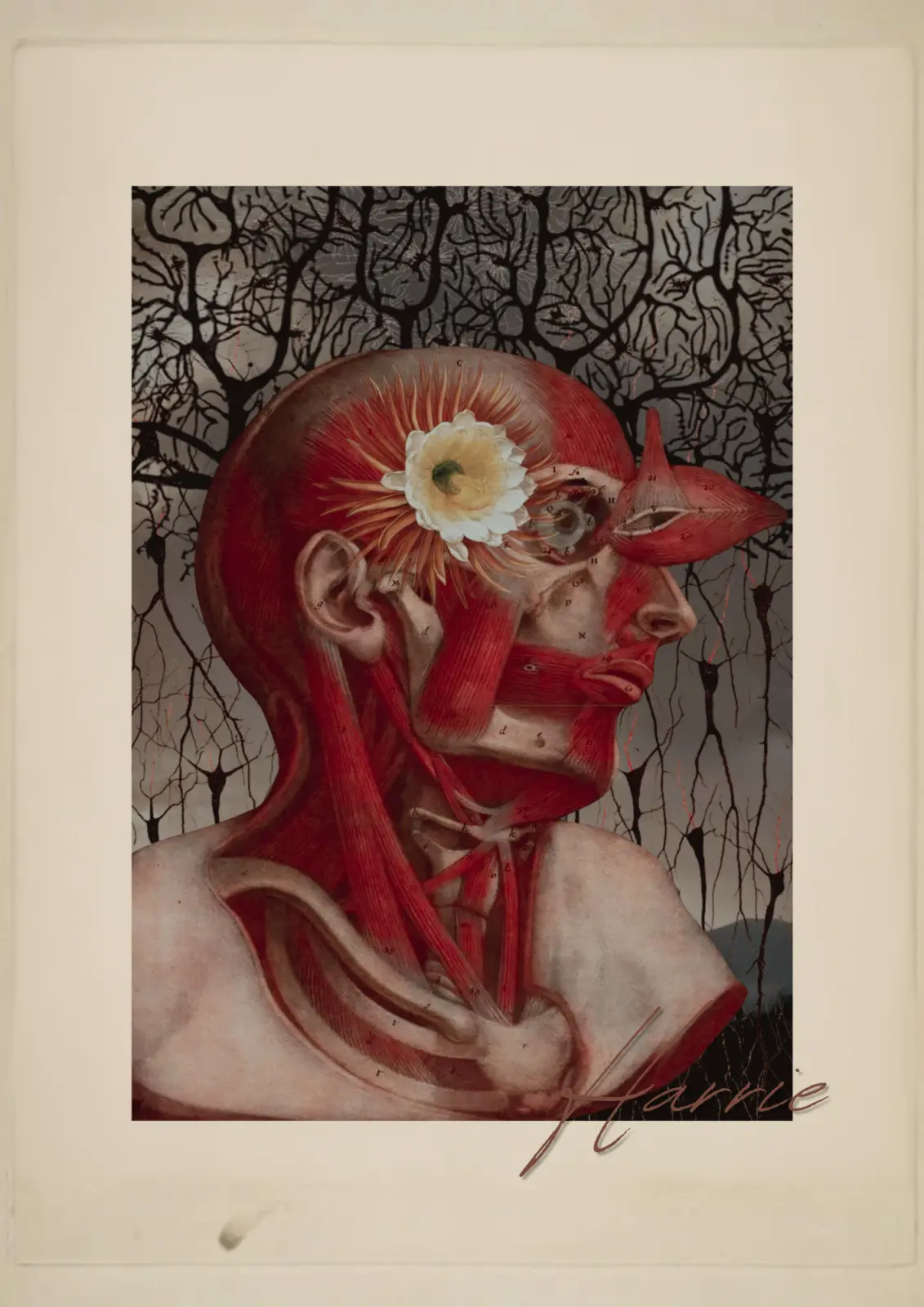
By Harrie Dearing. First published on harriedearingart.com.
I’ve just come out the other side of a real rabbit hole of a project, my first proper dive into digital collage, and I wanted to share about where it came from, what I’ve been raiding for source material, and where I think it’s going next.
This project actually started with my aunt, Michelle Whitmore , a fine art photographer and digital artist based here in Wiltshire. Michelle builds her pieces by taking photographs of flowers from her own garden and places she’s visited, then compositing them digitally with layered textures, sometimes finishing the prints by hand with gold leaf, acrylic paint and ink. Seeing her recent digital work got me thinking about what might happen if I applied that same idea of digital compositing to historical, archival art instead of photography, and then I fell into a rabbit hole.
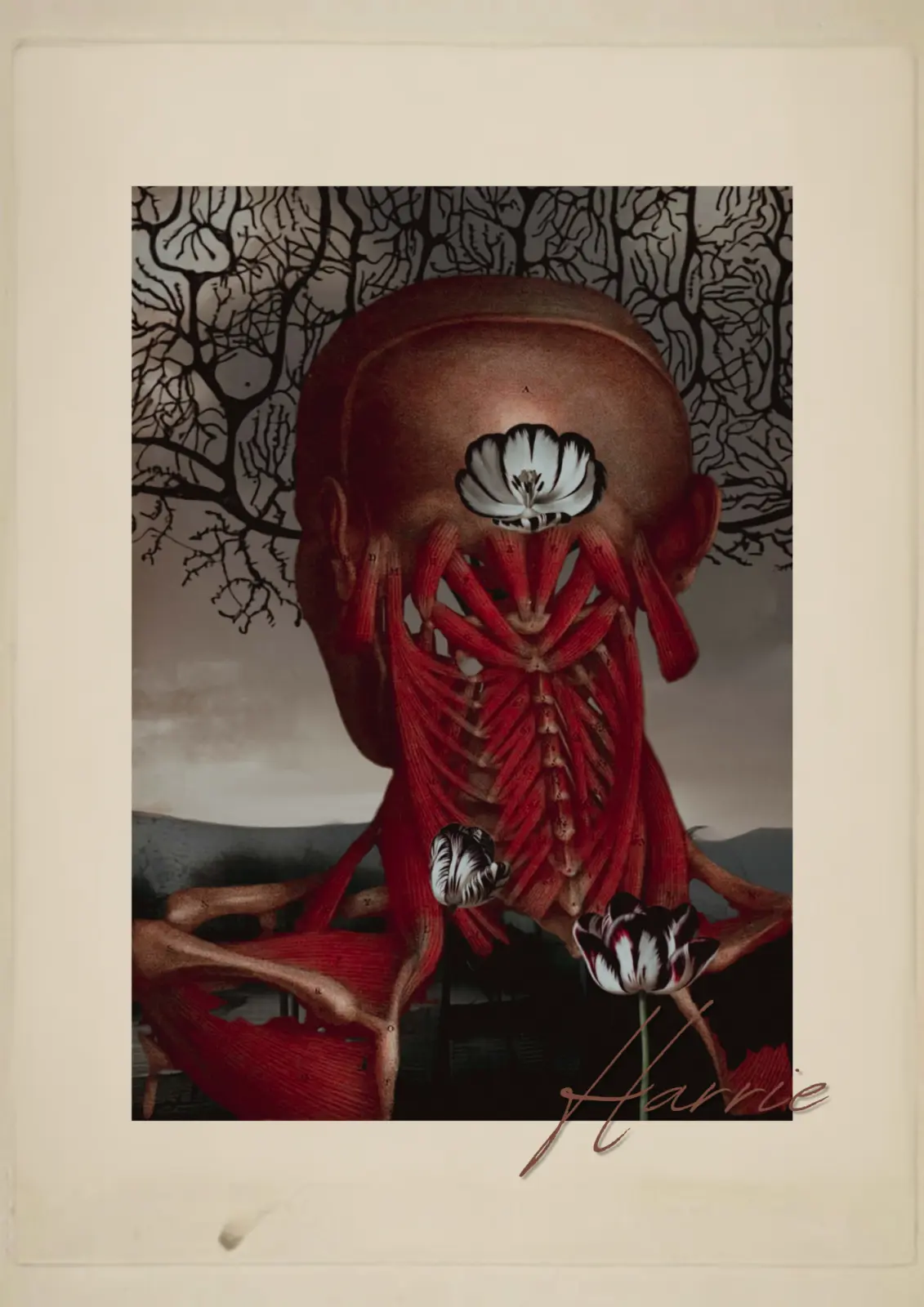
For a while now I’ve been wanting to find a visual language for what it actually feels like to live with FND (Functional Neurological Disorder), the migraines, the pressure points, the pain that runs down my neck and back, the sense that my own nervous system is putting on a storm I didn’t ask for. Words only get me so far with that. So I went looking for images instead, and ended up combining four very different historical archives into a set of surreal, beautifully disturbing digital collages.
Here’s the story behind each of them, and what they’re doing in the work.
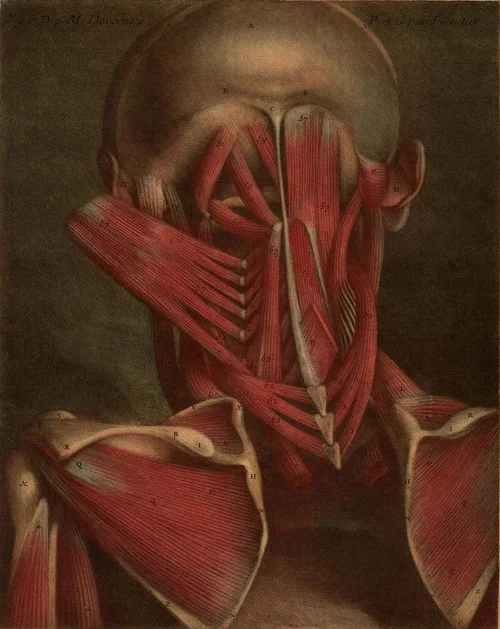
The raw anatomy: Gautier D’Agoty’s Essai d’Anatomie (1745)
The backbone of the series, literally, is a set of coloured mezzotint plates made in 1745 by the French anatomist and printmaker Jacques Gautier D’Agoty. They form a detailed atlas of the head, neck and shoulders, based on dissections carried out by the anatomist Joseph Duverney, and they are extraordinary objects in their own right: D’Agoty trained under Jacob Christoph Le Blon, who invented colour mezzotinting in 1719, a laborious process built up from three separate ink impressions (blue, yellow and red) pressed onto a plate that’s been roughened and selectively polished to hold varying amounts of ink. It’s a technique that was mostly used to reproduce famous paintings, which makes D’Agoty’s decision to use it for original anatomical illustration genuinely unusual… this is anatomy rendered with the tonal richness of a painting rather than the cold clarity of a diagram.
That richness, and the sheer rawness of exposed muscle and tissue in these plates, is why I’ve used them as the base layer in the collages, the “ground truth” of the body, laid open. I’ve placed them exactly where I feel my own neurological symptoms sit: the neck, the shoulders, the base of the skull. It felt important to start from real, exposed anatomy rather than anything softened or symbolic.
The storm underneath: Golgi and Cajal’s nervous system illustrations
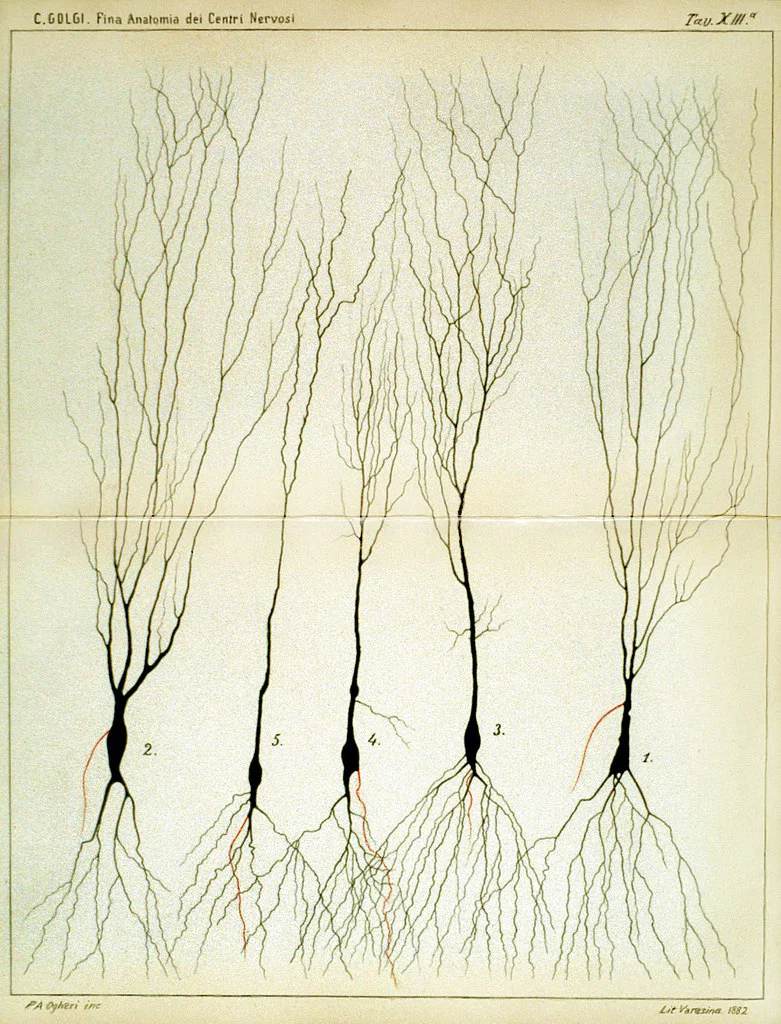
Layered behind the anatomy, like weather moving in, are illustrations from two nineteenth-century pioneers of neuroscience: Camillo Golgi and Santiago Ramón y Cajal. Golgi, working in a makeshift laboratory in an Italian hospital kitchen, developed a staining method, the “black reaction”, that deposited silver nitrate onto nerve tissue, suddenly making the branching structure of neurons visible under a microscope for the first time. Cajal, a rebellious kid from Spain who originally wanted to be an artist and only got into anatomy through helping his doctor father exhume bones from local cemeteries, then refined Golgi’s technique and used it to produce the delicate, spidery drawings of neurons that still shape how we understand the brain today.
What’s lovely (and a bit poignant, from where I’m sitting) is that the two men fundamentally disagreed about what their own discovery meant, Golgi thought neurons were fused into one continuous network, while Cajal’s work proved they were separate cells signalling across tiny gaps. They ended up sharing the 1906 Nobel Prize and famously used their joint lecture to argue with each other in front of everyone. I’ve used their branching, storm-like neuron drawings as a background texture in the collages, a visual stand-in for the electrical chaos of a nervous system that isn’t firing the way it’s supposed to, sitting behind the anatomy like weather rolling in.
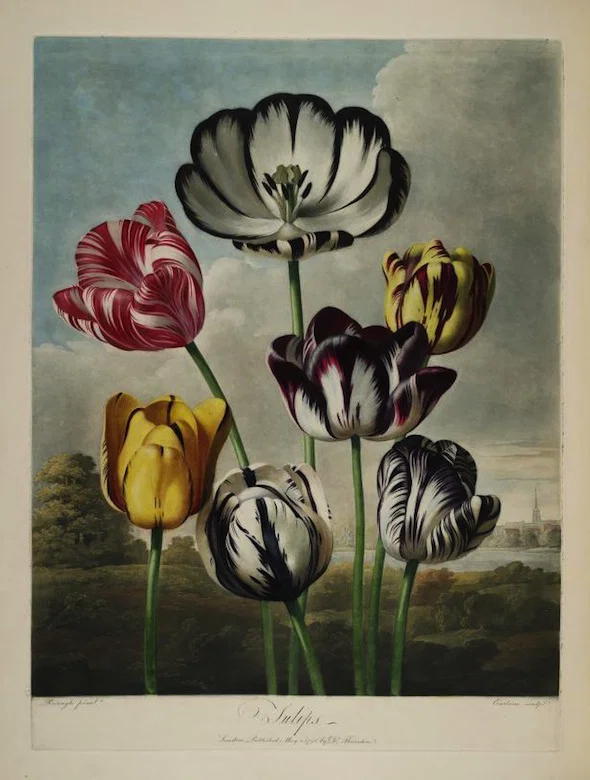
The pain, in flowers: Robert Thornton’s Temple of Flora (1807)
Where the migraines and pressure points sit, I’ve layered in botanical plates from Robert Thornton’s Temple of Flora, widely considered one of the greatest flower books ever produced. Thornton commissioned artists including Philip Reinagle and Peter Charles Henderson to paint flowers in wildly theatrical, oversized settings, engraved by Thomas Medland and others between 1798 and 1807. He originally planned seventy plates; the public didn’t share his enthusiasm, a lottery meant to rescue the project’s finances failed, and even a dedication to Queen Charlotte (patroness of botany) couldn’t save him from financial ruin. Only thirty-three plates were ever finished.
There’s something in that combination, obsessive, over-the-top beauty produced right alongside real financial and personal collapse, that resonates with how migraine and neurological pain actually feel to me: beautiful and consuming at the same time, blooming concentrations of energy, somewhere it really shouldn’t. I’ve used these blooms almost like flares or pressure points, marking the exact spots where the pain sits.
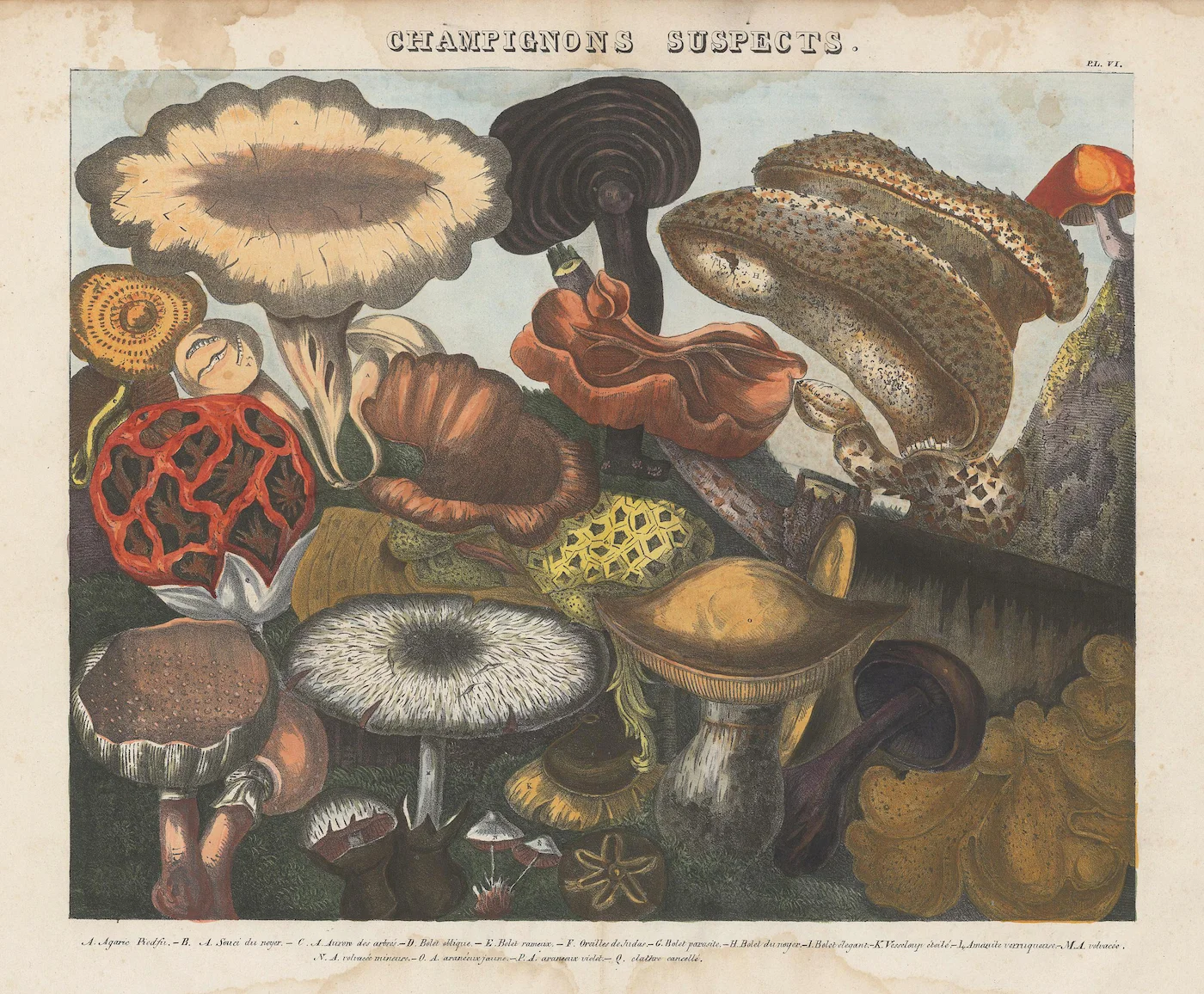
The warning signs: Descourtilz’s Atlas des Champignons (1827)
The fourth layer comes from a set of mushroom lithographs by A. Cornillon, made for the physician and botanist Michel Étienne Descourtilz’s Atlas des champignons: comestibles, suspects et vénéneux, edible, suspect, and poisonous. Descourtilz himself had led a genuinely strange life by the time he made this book: a French naturalist who travelled to Haiti in 1799 to try and save his family’s plantation, he was arrested during the Haitian Revolution and very nearly killed, escaping only because of his medical training. He spent four years there before returning to France to carry on with medicine and mushroom-hunting, seemingly unchanged by any of it.
His atlas sorts mushrooms into edible, suspect, and outright poisonous categories, species that can look almost identical while one feeds you and the other kills you. That uncertainty, that not being able to tell from the surface whether something is safe, is exactly the texture I wanted for the parts of these collages that speak to the unpredictability of FND: symptoms that look like one thing and turn out to be another, warning signs that are easy to misread.
Putting it all together
So the recipe, in short: D’Agoty’s exposed anatomy as the body itself, Golgi and Cajal’s neurons storming in the background, Thornton’s flowers marking the migraines and pressure points, and Descourtilz’s mushrooms carrying the sense of hidden danger and uncertainty. All four archives are over a century old, all public domain, and all completely different in purpose, medical atlas, scientific discovery, botanical extravagance, mycological field guide , and I’ve enjoyed pulling them into one frame to tell a very personal, very present-day story about a body doing things it wasn’t supposed to.
This is the first time I’ve really let myself play with digital collage rather than working straight onto canvas, and honestly it’s been a joy, and a bit of a revelation for how I actually work. I have aphantasia, so I don’t see pictures in my head the way a lot of artists describe; I can’t summon up a finished image in my mind’s eye before I make it. Collage gets round that beautifully. It’s a genuinely different way of thinking through an idea, piecing together new work as a visual story board, rather than starting with a blank page (or, in my case, a blank head).
What’s next
I don’t see these collages as finished pieces so much as source material for two follow-on experiments:
Printing and reworking by hand, getting these images out onto paper and back into physical materials, working into the prints with acrylic, inks, and gilding, much like I have with prints of my original artworks in the past ( very much influenced by my aunt Michelle’s practice )
Translating into oil paint, using the finished collages as visual references for a new series of paintings on canvas.
I’ll be sharing progress on both as they develop. For now, it’s been a genuine pleasure getting lost in these archives, there’s something quite special about pulling four centuries-spanning pieces of scientific and botanical history into a single, strange, and hopefully honest picture of what FND actually feels like from the inside.
If any of this has got you curious, there are so many incredible public domain archives out there to fall down your own rabbit hole in The Public Domain Review is a brilliant place to start if you fancy having a go at digital collage in your own practice. For anyone wondering about the technical side, I pulled these particular pieces together and edited the final images using a mix of Canva, Photoshop, and Lightroom…
Go find you rabbit hole & create something new !
Sources: Golgi and Cajal’s nervous system illustrations, Gautier D’Agoty’s Essai d’Anatomie, Robert Thornton’s Temple of Flora, and Descourtilz’s Atlas des Champignons, all via The Public Domain Review.